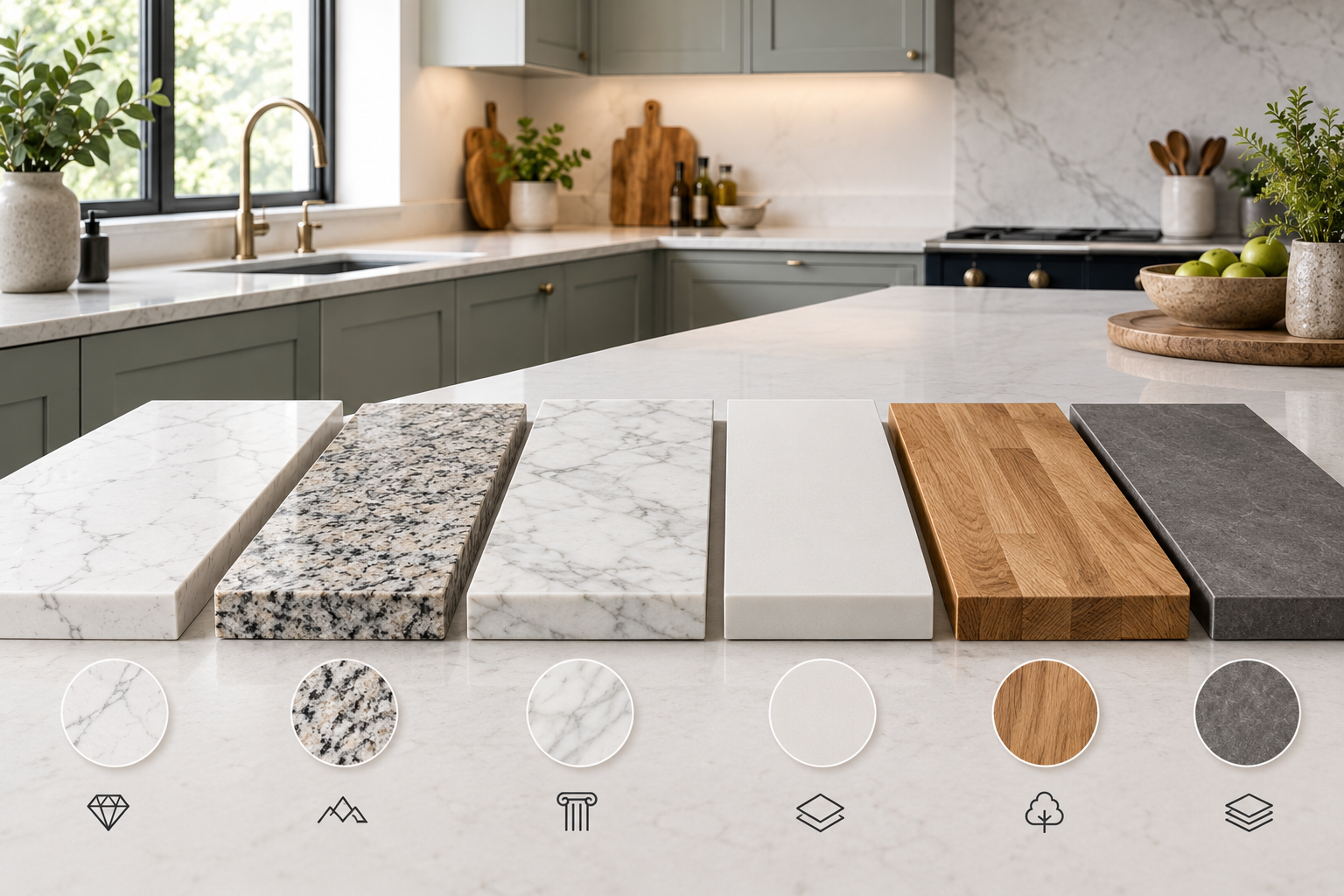
Most people choose a worktop by colour first. That makes sense: it is the part of the kitchen you see most. But the material decides how the worktop behaves once you start living with it, and that is where most regrets come from: the laminate that swelled at the sink joint after two years, the oak that went grey around the tap, the marble that picked up a ring from a glass of wine on the first weekend.
This guide looks at the eight worktop materials you are most likely to be offered in the UK. For each one, we cover what it is made of, how it copes with real kitchen life (heat, knives, water, cleaning), what it needs from you, and the practical details that rarely come up in a showroom, such as joins, weight, thickness and sink options.
If you only have a minute, here is the short version:
- Quartz is the best fit for most family kitchens. It is hard, does not stain, never needs sealing and comes in hundreds of finishes. Its one real weakness is direct, intense heat.
- Marble is the choice for looks above all. It is softer and more reactive than quartz, so it suits careful cooks and people who like a surface that shows its age.
- Laminate is the most budget-friendly and the easiest to fit, but it is the least forgiving of water, heat and knives.
- Solid wood brings warmth no stone can match, in exchange for regular oiling and care around the sink.
- Porcelain and sintered stone handle heat and sunlight better than anything else here, but edges need care and design options are narrower.
- Solid surface, stainless steel and concrete are more specialist choices, each excellent in the right kitchen.
1. Quartz worktops
What it is
Quartz worktops are engineered stone: roughly 90–93% crushed natural quartz, with the rest made up of polymer resin and pigments. The mix is compacted under vacuum and vibration, then cured into slabs. Because the recipe is controlled, the manufacturer decides the colour and pattern, which is why one slab of a design looks like the next.
In the UK, quartz worktops are usually made in 20mm or 30mm thicknesses. A 20mm slab looks slim and modern. A 30mm slab has more visual weight and is often chosen for islands and traditional kitchens.
Living with it
Quartz scores around 7 on the Mohs hardness scale, the same as the mineral it is made from. In practice, that means a knife dragged across it will blunt before the worktop scratches, and everyday knocks from pans and plates rarely leave a mark.
The resin fills the gaps between the quartz grains, so the surface is non-porous. Coffee, red wine, turmeric and cooking oil sit on top rather than soaking in. It never needs sealing, and the daily routine is simply warm water, a little washing-up liquid and a soft cloth. In hard-water areas such as London and the South East, drying the surface after wiping prevents limescale spots building up around the tap.
Where it falls short
The resin is also quartz’s weak point. A pan taken straight off a gas ring, a roasting tin from a hot oven, or a slow cooker left in one place for hours can scorch the resin or, in rare cases, cause a crack from sudden temperature change. A trivet solves this completely, but it does need to become a habit.
Quartz is also not designed for outdoor kitchens. Over time, strong sunlight can cause the resin to discolour.
Practical details
- A standard slab is about 3m long, so a long run or L-shaped kitchen will need at least one join. A good fabricator colour-matches the join and positions it away from the sink and hob.
- Quartz is heavy: a 30mm worktop weighs roughly 70kg per square metre. Base cabinets need to be level and solid before templating.
- Undermounted sinks, drainer grooves, hob cut-outs and matching upstands can all be cut from the same material.
- Fitting involves templating after the cabinets are installed, then fabrication and a separate fitting visit, so plan a gap between the two in your kitchen schedule.
Our take: quartz is the material we would recommend to most households. It suits people who cook a lot, have children, or simply do not want to think about their worktop. Read our full guide on how to clean and care for quartz worktops.
2. Marble worktops
What it is
Marble is a natural metamorphic stone, formed when limestone is transformed by heat and pressure. It is mostly calcite, and its famous veins come from other minerals running through the rock. Carrara, with its soft grey veining, and Calacatta, with bolder veins on a brighter white background, are the best-known Italian types.
Every slab is different. Many people visit the stone yard to choose the exact slab for their kitchen.
Living with it
Marble stays naturally cool, which is why bakers have used it for rolling pastry for centuries. It also copes with warm dishes better than quartz.
The trade-off is chemistry. Calcite reacts with acid, so lemon juice, vinegar, tomato sauce and wine can leave dull marks called etching, even when wiped up quickly. This is different from staining: it is a change to the polished surface, not something soaked in. Honed (matt) marble shows etching far less than polished marble.
Marble is also porous and softer, at around 3 on the Mohs scale, so it needs sealing and can scratch or chip at the edges.
What it needs from you
- Reseal regularly. A simple test is to leave a few drops of water on the surface: if it darkens within a few minutes, it is time to reseal.
- Clean with a pH-neutral stone cleaner. Avoid vinegar, lemon-based sprays and most bathroom cleaners.
- Use chopping boards and coasters, especially on polished marble.
Our take: marble is for people who see wear as character. If you want the look without the upkeep, marble-effect quartz is the practical alternative. Our full comparison of quartz vs marble worktops covers this in more depth.
3. Laminate worktops
A laminate worktop is a thin decorative layer (a printed paper sealed in resin) bonded to a thick core of chipboard or MDF. Standard laminate worktops in the UK are usually around 38–40mm thick, and many have a rounded “post-formed” front edge. Modern prints imitate stone, wood and concrete well enough that, from across the room, it can be hard to tell.
Laminate is the obvious choice when budget matters most. It is light, so it can be cut and fitted on the day with ordinary tools, and many confident DIYers fit it themselves.
The weaknesses all come from that thin top layer and the wooden core beneath it:
- Water. The surface itself is water resistant, but the core is not. If water gets into a poorly sealed joint, a cut edge or the sink cut-out, the chipboard swells and the surface lifts. This is the most common way laminate fails.
- Heat. A hot pan can blister or discolour the surface in seconds, and the damage cannot be repaired.
- Knives. Cutting directly on laminate leaves permanent scratches.
- Sinks. Standard laminate can only take an inset (sit-on) sink, not an undermounted one, because the core would be exposed.
If you choose laminate, ask for joins to be sealed properly and avoid placing a join near the sink. Wipe up standing water rather than leaving it to sit at the back of the worktop.
Who it suits: rental properties, utility rooms, short-term kitchens and tight budgets.
4. Solid wood worktops
Solid wood worktops are made from staves of timber glued together, usually 27mm or 40mm thick. Oak is the most popular in the UK, with walnut offering a darker, richer tone, and iroko often chosen near sinks because its natural oils make it more water tolerant.
Wood brings something no stone can: warmth, both visual and to the touch. It is quieter too: plates and pans do not clatter on wood the way they do on stone. And unlike most surfaces, it can be renewed. Scratches, rings and minor burns can be sanded out and the surface re-oiled.
The price of that is maintenance. Wood is alive in the sense that it reacts to moisture:
- New worktops need oiling several times before use, then regularly afterwards. A good sign it needs another coat is when water stops beading and starts soaking in.
- The area around the sink and tap is the danger zone. Water left sitting there turns oak grey or black over time, and repeated wetting can cause cracks.
- Hot pans will scorch it, and acidic or coloured foods can stain unoiled patches.
- Wood moves with humidity, so it should be fitted with room to expand and never sealed tight against walls.
Who it suits: people who love natural materials and do not mind a little regular care. A popular compromise is a durable stone worktop around the sink and hob, with a wooden breakfast bar or island top where water and heat are less of an issue.
5. Porcelain and sintered stone worktops
Porcelain and sintered stone are made by pressing natural minerals (clays, feldspar, silica) and firing them at well over 1,000°C. There is no resin, so the result is extremely dense and almost completely non-porous. Slabs are often thin, commonly 12mm, which gives a sharp, contemporary look.
With no resin to scorch, porcelain handles heat better than any other worktop in this guide, and it is UV stable, which makes it one of the few materials suitable for outdoor kitchens. It also resists scratches and stains very well.
Its weak point is the edges. Porcelain is hard but brittle, so a heavy pan knocked against a corner can chip it. On many porcelain worktops, the pattern is printed on the surface rather than running through the whole slab, so a chip or a cut edge may reveal a plain body underneath. Ask whether a design is “full-body” or surface-printed before you choose it, especially if you want a thick mitred edge or an undermounted sink.
Porcelain also needs a fabricator with the right equipment and experience, which narrows your choice of suppliers.
Who it suits: ultra-modern kitchens, outdoor kitchens and cooks who want maximum heat resistance.
6. Solid surface worktops
Solid surface (Corian is the best-known brand) is made from acrylic resin blended with mineral fillers. Its big advantage is that pieces are bonded together with an adhesive of the same material, so joins are practically invisible. Sinks and drainers can be moulded into the worktop as one continuous piece, with no rim where dirt can collect.
It is also warm to the touch and repairable: light scratches can be buffed out.
On the other hand, it is much softer than stone, so it scratches more easily, and hot pans can mark it. It also has a smoother, more uniform look than natural stone, which some people find too synthetic.
Who it suits: minimalist kitchens with curves, long seamless runs or integrated sinks.
7. Stainless steel worktops
Stainless steel is the standard surface in restaurant kitchens because it is hygienic, heatproof and almost impossible to stain. In a home, it gives a professional, industrial look.
Expect it to change, though. Steel scratches with every pan and knife, and those fine scratches soon blend into a soft patina. A brushed finish hides marks better than a polished one. It also dents if something heavy is dropped, shows fingerprints, and can be noisy.
Who it suits: serious home cooks and industrial or professional-style kitchens.
8. Concrete worktops
Concrete worktops are either poured on site or cast in a workshop and installed in sections. They can be made in almost any shape and thickness, and every one is slightly different.
Concrete is porous, so it needs sealing to resist stains, and the sealer needs renewing over time. Hairline cracks are common as concrete cures and settles, and many owners accept them as part of the look. It is also extremely heavy, so cabinets and sometimes floors need checking first.
Who it suits: industrial and loft-style kitchens. If you love the look but not the upkeep, concrete-effect quartz gives a similar finish with none of the sealing.
Details to decide before you choose
The material is only half the decision. These details affect how the finished kitchen looks and works, and some of them rule certain materials in or out.
Sink type
An undermounted sink sits beneath the worktop, so you can wipe crumbs straight into it and there is no rim to clean around. It needs a solid material that can have a polished cut-out edge: quartz, marble, porcelain, solid surface or wood. Standard laminate only takes an inset sink that sits on top.
Drainer grooves
Grooves cut into the worktop beside the sink replace a draining board. They work well in quartz, marble and porcelain. In wood, they are best avoided, because they hold water in exactly the place wood dislikes most.
Thickness
Thinner worktops (12–20mm) look light and modern and suit handleless kitchens. Thicker worktops (30–40mm) look more substantial and suit traditional kitchens and large islands. If you want a thick look in a stone material, a mitred edge can make a 20mm worktop appear much thicker at the front.
Joins
Stone slabs come in fixed sizes, so long runs and L-shapes need joins. Ask your supplier where they will go before you commit. Solid surface is the only material where joins genuinely disappear.
Upstands and splashbacks
A short upstand (usually around 100mm) in the same material protects the wall and gives a clean finish. A full-height splashback behind the hob in the same stone looks striking and is easy to wipe down.
Weight and cabinets
Stone, porcelain and concrete are heavy. Cabinets must be level, square and fixed securely before a stone worktop is templated, which is why stone is measured and fitted after the units are in, not at the same time.
How to choose: match the material to your kitchen
Rather than a single “best”, it helps to start from how you use your kitchen.
You cook every day and have a busy household. Choose quartz. It is the most forgiving surface for spills, knives and constant cleaning, and it needs nothing from you except a trivet for hot pans.
You want a statement kitchen and do not mind some wear. Choose marble, ideally honed rather than polished, or a marble-effect quartz if you want the look with less care.
You are renovating on a tight budget or for a rental. Choose laminate, and pay attention to how the joins and sink cut-out are sealed.
You love natural textures and enjoy looking after things. Choose solid wood, or combine a wooden island with a stone worktop around the sink.
You cook outdoors or want maximum heat resistance. Choose porcelain, and check whether the design is full-body.
You want seamless curves or an integrated sink. Choose solid surface.
Still deciding on colour? See our guide to what colour worktop goes with your kitchen, or browse 30 kitchen worktop ideas.
Frequently asked questions
What is the most durable kitchen worktop?
For everyday family use, quartz and porcelain are the most durable. Quartz is the more forgiving of the two: it resists scratches and stains and is less likely to chip at the edges. Porcelain is the better choice where heat or sunlight is the main concern.
Which worktop needs the least maintenance?
Quartz. It never needs sealing or oiling, and warm soapy water is all it needs day to day. Porcelain and stainless steel are also low maintenance. Marble, wood and concrete need the most care.
Can you put hot pans on a kitchen worktop?
Only on porcelain, sintered stone and stainless steel without worry. Marble copes reasonably well. Quartz, solid surface, laminate and wood can all be damaged by a pan straight from the hob or oven, so use a trivet.
Which worktop is best for hard water areas?
Non-porous surfaces such as quartz and porcelain are easiest to keep free of limescale. Wipe and dry around the tap regularly. Avoid acidic descalers on marble and quartz, and on wood, keep the area around the sink well oiled.
How long do kitchen worktops last?
It depends heavily on the material and how it is treated. A well-fitted laminate worktop typically lasts around ten years before wear shows. Solid wood can last for decades if it is oiled and kept dry around the sink. Quartz, porcelain and marble can last as long as the kitchen itself.
Can I fit a worktop myself?
Laminate and wood are often fitted by confident DIYers. Quartz, marble, porcelain, solid surface and concrete need professional templating, fabrication and fitting because of their weight and the specialist tools involved.
Can I mix different worktop materials?
Yes, and it often gives the best of both. A common combination is quartz around the sink and hob, where durability matters most, with a wooden or contrasting stone worktop on the island.
The bottom line
Every material in this guide is the right answer for someone. Marble is for people who value natural beauty over perfection. Wood is for people who enjoy caring for their kitchen. Laminate is for tight budgets and short-term plans. Porcelain is for heat, sunlight and sharp modern lines.
If you want one surface that copes with daily cooking, children, spills and busy mornings, and still looks the way it did on the day it was fitted, quartz is the material we would choose for most UK kitchens.
Thinking about quartz? Browse our quartz worktops collection to see the full range of colours and finishes, or request a free estimate and our team will talk you through the options for your kitchen.